| CKO | CKO/DEG | |
|---|---|---|
α mutations |
C63A, R178A, R204A | C63A, R178A, R204A, T240W |
β mutations |
C30A | C30A, S520K |
γ mutations |
C33A, C41A, R138A | C33A, C41A, R138A |
Appendix A — Materials and Methods
A.1 ENaC Expression
A.1.1 Human ENaC
Human embryonic kidney cells (HEK293T/17) were grown in suspension in Freestyle medium with 2% FBS at a density of 2 – 4\(\times 10^6\) cells/mL. BacMam virus carrying the genes for the appropriate ENaC subunits were added to the flasks at an MOI of 1 and incubated at 37 °C for 8 hours, after which 1 μM amiloride was added and the flasks were moved to 30 °C. After a total incubation time of 72 hours, cultures were centrifuged at 4,790 xg for 20 minutes to collect pellets. The pellets were washed with TBS (20 mM Tris pH 8.0, 200 mM NaCl) and centrifuged again before snap-freezing in liquid nitrogen. Cell pellets were stored at -80 °C until use.
A.1.2 Mouse ENaC
Sf9 cells were grown in suspension in Sf900-II serum-free media at 27 °C. Cells were infected at log phase with virus encoding full-length mouse ENaCα, ENaCβ, and ENaCγ. After 5–6 hours of growth, 1 μM amiloride was added to the culture. Cells were harvested 24 hours later, washed with TBS, flash frozen in liquid nitrogen, and stored at -80 °C until used.
A.2 ENaC Purification
A.2.1 Human ENaC
Throughout this protocol, quantities of resin and buffer are given “per flask”. I grow cell culture in quantities of 800 mL culture per flask, meaning that, e.g., pelleted cells from 1.6 L of cells require twice the quoted quantities of buffer and resin. In datasets with NaCl listed as the salt, solubilization buffer, wash buffers, elution buffer, and SEC buffer used NaCl in place of KCl.
To purify ENaC, frozen whole-cell pellets were removed from the -80 °C freezer and thawed in a 37 °C water bath. While the pellets were thawing, 50 mL Solubilization Buffer was prepared per flask:
- 20 mM Tris pH 7.5, 200 mM KCl
- 1 tablet per 100 mL Pierce EDTA-free protease inhibitor tablets
- 25 U/mL ThermoFisher universal nuclease
- 2.5 mM ATP, 5 mM MgCl2
- 10 mg/mL digitonin
- 10 μM amiloride
The solubilization buffer was prepared fresh at 2x concentration (i.e., half the final volume). Once pellets were fully thawed, they were added to the solubilization buffer and the mixture was brought to the final volume with DI water and poured into a screw-cap bottle. The solubilization mixture was left at 8 °C for 1.5 hours.
After solubilization was complete, the crude lysate was decanted into ultracentrifuge tubes and centrifuged at 100,000 xg for 45 minutes at 4 °C. Meanwhile, in-house-made GFP-nanobody CNBr resin (0.8 mL per flask) was loaded into an XK 16 column and washed with 2 CV of TBK
- 20 mM Tris pH 7.5
- 200 mM KCl
and the following buffers were prepared in the listed quantities:
wash A (10 column volumes [CV]):
- 20 mM Tris pH 7.5, 200 mM KCl
- 0.7 mg/mL digitonin
- 2 mM MgCl2
- 2 mM ATP
- 2 nM phenamil
wash B (10 CV):
- 20 mM Tris pH 7.5
- 200 mM KCl
- 0.7 mg/mL digitonin
- 5 mM CaCl2
- 2 nM phenamil;
elution buffer (5 CV): wash B with 33 μg/mL thrombin
The column was washed with 2 CV of wash A, then clarified lysate was bound to the column under 4 mL/min flow. A small aliquot of pre-column and post-column clarified lysate was reserved to assess binding efficiency by GFP FSEC1. If binding efficiency fell below 90% of the initial efficiency the resin was discarded. Otherwise, it was regenerated with pulsed pH cleaning. The GFP-nanobody column was washed with 5 CV wash A and B.
To elute ENaC from the GFP nanobody resin, the column was washed 3 times with 1.5 CV elution buffer and once with TBK with 0.7 mg/mL digitonin. As each wash was flowed on, the eluant was collected in 1 mL or 0.25 CV fractions, whichever was smaller. This results in four sets of fractions: the first comprises largely wash B with little protein (from the initial flow-on of elution buffer), and the remaining three elution buffer. All fractions were run on an SDS-PAGE gel, and fractions with bands at the expected molecular weight for ENaC were pooled and concentrated to a final volume of 0.5 mL. If the preparation was acid-shocked, the protein was desalted into acid shock buffer at this stage:
- 20 mM Tris pH 6
- 200 mM KCl
- 0.7 mg/mL digitonin
- 2 nM phenamil
If the preparation required Fabs, they were added in two-fold excess of protein concentration (as determined by nanodrop A280) at this stage. A final concentration of 1 mM C8 PIP2 was added to the CKO/DEG monofab samples just before grid preparation.
The concentrated eluant was loaded onto a Superose 6 Increase 10/300 column (Cytiva) equilibrated in SEC buffer for further purification via SEC.
- 20 mM Tris pH 7.5
- 200 mM KCl
- 0.7 mg/mL digitonin
- 2 nM phenamil
SEC was typically run overnight, meaning fractions remained at 4 °C until the next morning. Fractions from the SEC peak were collected and assayed for purity and monodispersity by SDS-PAGE and tryptophan FSEC. Monodisperse peaks were pooled and used the same day. Thus, total time between cell pellet thaw and protein use was typically less than 36 hours.
A.2.2 Mouse ENaC
Frozen cell pellet was thawed on ice. Membranes were prepared by sonication and centrifugation, then re-frozen until purification. For each gram of membranes, 15 mL of solubilization buffer was added
- 4 mM GDN
- 20 mM HEPES pH 7.6
- 150 mM NaCl
- 2 mM ATP
- 2 mM MgSO4
- 1 mM TCEP
- 100 μM amiloride
- 1 tablet per 100 mL Pierce EDTA-free protease inhibitor tablets
Membrane pellet was mixed thoroughly and homogenized with a Dounce homogenizer. Cell pellet was stirred for 1 hour at 4 °C. Solubilized membranes were centrifuged at 100,000 xg for 45 minutes at 4 °C.
Next, 300 μL GFP nanobody CNBr resin per gram of membrane was loaded into a gravity column and washed with 10 CV HBS
- 20 mM HEPES pH 7.6
- 150 mM NaCl)
and 3 CV wash A
- 0.1 mg/mL GDN
- 20 mM HEPES pH 7.6
- 150 mM NaCl
- 1 mM TCEP
- 100 nM phenamil
Clarified lysate was flowed over this column under gravity. The column was washed with 6 CV each of wash A, wash B (wash A with 2 mM ATP, 2 mM MgSO4), wash C (wash A with 25 U/mL ThermoFisher Universal Nuclease), and elution buffer (wash A with 5 mM CaCl2). ENaC was eluted by flowing 1 CV of elution buffer with 30 μg/mL thrombin onto the column and collecting the supernatant. After an hour, this process was repeated. These elution steps were repeated for a total of four elutions of 1 CV each.
The first three elutions were pooled and concentrated to 0.5 mL. Fab was added at a one-to-one ratio with nominal protein concentration by nanodrop. Sample was incubated for 10 minutes at room temperature, then centrifuged at 100,000 xg for 20 minutes at 4 °C. The clarified sample was loaded onto a Superose 6 Increase 10/300 column (Cytiva) equilibrated in fresh wash A buffer. Fractions were assessed for purity via SDS-PAGE and FSEC before proceeding to grid preparation or other uses.
A.3 ENaC nanodisc preparation
To prepare nanodiscs, 15 mg of a chloroform stock of POPC (Avanti) was dried down under an argon stream. The lipid film was left overnight in a vacuum desiccator to remove all chloroform. The lipids were then resuspended in 350 μL reconstitution buffer
- 20 mM HEPES pH 7.4
- 100 mM KCl
- 1 mM EDTA
and sonicated until the solution was milky in appearance and no lipids remained adhered to the sides of the tube, typically 5–10 minutes. To this solution, 150 μL of 350 μM DM in reconstitution buffer was added. The resulting 500 μL suspension was sonicated in 5 minute bursts until completely clear. To this suspension, 1 mL TBS was added to prepare a final lipid concentration of 10 mg/mL.
Lipids, ENaC, and MSP2N2 were mixed at a final MSP:POPC:ENaC molar ratio of 1:31:0.04. The final concentration of MSP2N2 was kept at 100 μM by further concentrating ENaC or adding lipid reconstitution buffer with 35 mM DM as necessary. This reconstitution mixture was incubated at room temperature for 1 hour. During this incubation, biobeads were washed once in 100% methanol, three times in water, and once in TBS. After 90 minutes, 215 mg washed biobeads per 1 mL reconstitution mixture were added. After 1 hour, the reconstitution mixture was moved to a fresh aliquot of equilibrated biobeads and left nutating overnight at room temperature, approximately 16 hours. The reconstitution mixture was pipetted off the biobeads, filtered with a 0.2 μm filter, and purified via SEC using a Superose 6 Increase 10/300 column in TBS. Typical yields were extremely low, between 5–10% of input ENaC. The protein assembly was stable with minimal aggregation at 4 °C (assessed by cryoEM and SEC) for at least two weeks.
A.4 Western Blots
SDS-PAGE gels were blotted onto nitrocellulose membranes. Membranes were blocked in 50 mg/mL milk in TBST for 1 hour at room temperature. Primary antibody (ENaCα: Santa Cruz Biotechnology αENaC (H-95) sc-21012 lot no. L2812; ENaCγ: abcam Anti-epithelial Sodium Channel gamma ab133430) was added to this same blocking buffer at 10 μg/blot and incubated overnight at 4 °C. Membranes were washed 3 times with TBST for 5 minutes before addition of secondary antibody (LI-COR IRDye 800 CW Goat anti-Mouse 925-32210 lot no. D21115-21) in TBST. Membranes were incubated at room temperature with secondary for 1 hour, washed 3 times with TBST and once with TBS, then imaged (LI-COR Odyssey DLx).
A.5 cryoEM Grid Preparation
Grid preparation different slightly for each dataset, but followed the same general procedure (Table A.2). Purified GFP-cleaved ENaC was concentrated for grid preparation just before blotting and freezing. All grids were glow discharged at 15 mA for 60 seconds on a Pelco easiGlow before blotting. Grids were frozen using a Vitrobot Mark III (Thermo Fisher). Vitrobot parameters were set as follows: blot time 2, wait time 0, drain time 0, blot force 1, humidity 100%, temperature 12 °C. “Double-blotted” grids had a protein droplet loaded, manually blotted with torn Whatman filter paper, and a fresh droplet loaded onto the grid before Vitrobot blotting (with Vitrobot filter paper rings) and freezing. This double-blotting process typically took approximately five seconds from first drop to plunge-freeze. In all cases, each protein droplet was 3 μL.
A.6 cryoEM Data Collection
Datasets were collected using SerialEM by microscopy core staff at the facilities used (Table A.3)2. In all cases, multi-shot multi-hole regimes were used to maximize the number of movies recorded. Number of shots per hole and maximum beam shift were a function of ice quality and grid type, but typically a 3x3 pattern of holes was imaged 2–4 times per hole.
A.7 cryoEM Image Processing
Each dataset was processed slightly differently, but following the same general pipeline. First, movies were imported into cryoSPARC for pre-processing. Default parameters were used for both motion correction and CTF estimation. Next, particles were picked using the blob picker in cryoSPARC. Adjustments were made to the minimum and maximum radii to account for the number of Fabs present in each sample. Blob picks for several micrographs were manually inspected and adjusted. First, the NCC parameter was adjusted until few contaminant and carbon-edge picks remained. Next, in a low-defocus micrograph, the low power threshold was adjusted to remove empty ice picks. Finally, in a high-defocus micrograph, the high power threshold was adjusted to remove all carbon-edge and contaminant picks. These initial blob picks were cleaned by 2D classification, and the resulting particle sets used to generate templates for template picking. Template picked thresholds were adjusted as for blob picked particles.
The template picked particles were repeatedly 3D classified using heterogeneous refinement in cryoSPARC, providing one “good” class and a number of “junk” classes (typically noisy or bad ab initio models of the blob picked particles) until all particles produced reasonable ENaC classes. The final particle set was never 2D classified, since I find that 2D classification reduces the frequency of rare particle views. From this point, processing proceeded ad hoc to produce the final maps (Image Processing).
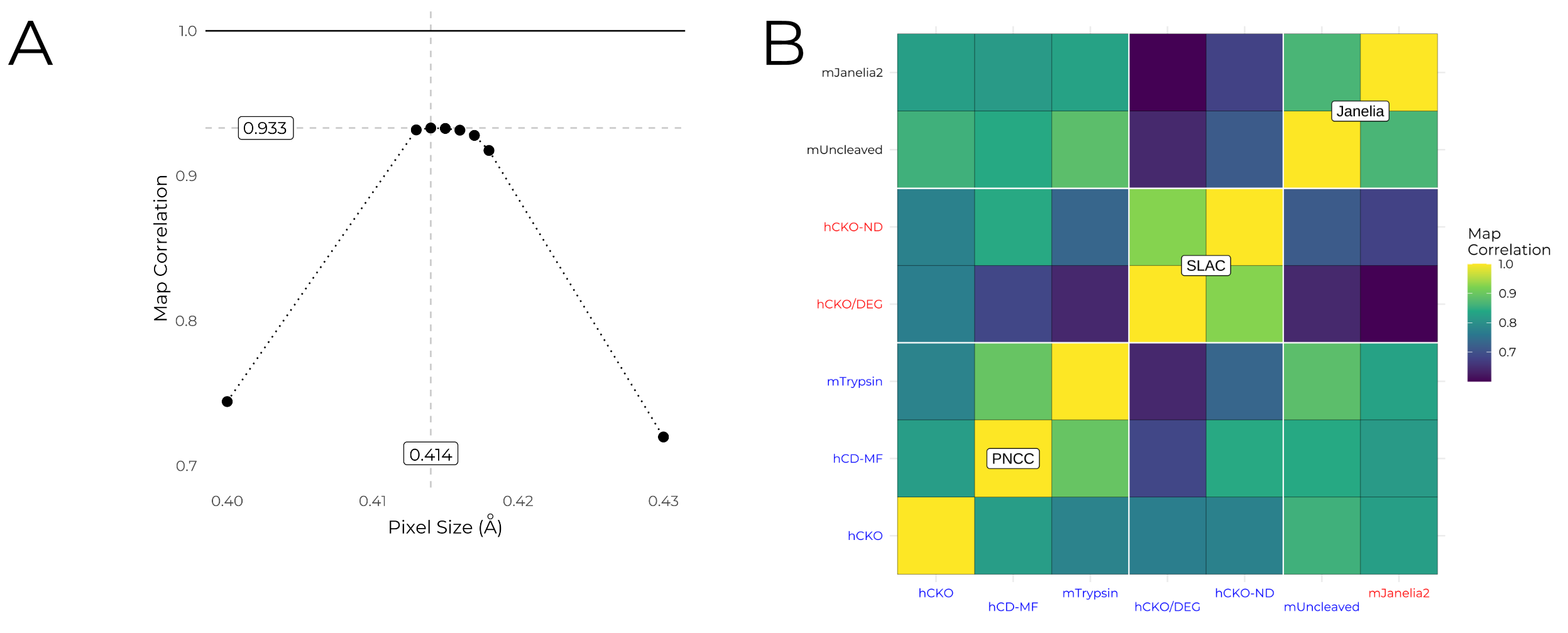
During image processing, I began to suspect that the pixel sizes provided by S2C2 are likely miscalibrated. First, other users reported pixel size calibration issues with S2C2 microscopes around the time these datasets were collected (Patrick Mitchell, S2C2 Director of Operations, personal communication). Second, scaling the CKO/DEG difab pixel size from the nominally-correct 0.43 to 0.414 (a change of approximately 3.6%) changes the map correlation value from 0.72 to 0.93 (Figure A.1 A). Finally, a comparison of the correlation between seven recently-collected ENaC maps shows that S2C2 is an outlier, with unscaled maps generated from data collected at PNCC and Janelia Farm correlating better with themselves and each other than with those collected at S2C2 regardless of construct (Figure A.1 B). I therefore decided to scale both S2C2 maps to correlate best with the same condition and construct recorded at PNCC after processing was complete. I present the models built into the scaled maps in this work.
A.8 Model Building
The starting model for mouse ENaC was generated using a local installation of AlphaFold3. The amino acid sequences for mENaC α (Uniprot ID Q61180), β (Uniprot ID Q9WU38), and γ (Uniprot ID Q9WU39) were joined using 10xGS linkers between α and β, and β and γ. This meta-sequence was then entered as the AlphaFold target. The linkers and large, unstructured, low-confidence loops were removed from the model before proceeding.
Before docking into experimental maps, starting models had Fabs and waters deleted to ease early model building steps. Initial models were rigid-body fitted into the experimental maps. Any loops in poor or missing regions of the map were deleted. The whole models were simulated with distance restraints using ISOLDE and ChimeraX4,5. Once models were roughly fit into the potential, strained distance restraints were released. Once the backbone appeared to fit reasonably well into the map, all distance restraints were released. Simulating one chain at a time, a pass over every residue in ENaC was performed, focusing on Ramachandran values and rotamers. Once all chains had been optimized in this manner, glycans were added using Coot’s carbohydrate module6. Fabs were rigid-body fitted and simulated similarly to the initial models once these steps were complete.
Models were refined using Phenix real-space refinement7. In some cases, the TMD map was used as-is for refinement. In other cases, the ECD and TMD map were combined using Phenix’s “Combine Focused Maps” job and the resulting map was used for refinement. In these cases, the lowest GSFSC resolution was provided to Phenix. Parameters were left as default, except rotamers were only refined when they had both poor map quality and were outliers (rather than or). I changed this setting because rotamer and clash statistics were significantly worse if it was left as the default. Model quality was assessed using MolProbity within Phenix, Q-scores calculated in ChimeraX, and 3DFSC as implemented in cryoSPARC (Table A.4 and Appendix D)8–10.
A.9 Constructs
The four constructs I present here can broadly be split into those I expect to be open (CKO/DEG and mouse trypsin) and those I expect to be closed (CKO, mouse) (Table A.1). All human channels in this work have mutant furin sites (αR178A R204A and γR138A). Additionally, all human channels are “cysteine knock-out” (CKO) mutants, with the following mutations: αC63A, βC30A, and γC33A C41A. Some (but not all) cysteines in the ENaC TMD are known to be palmitoylated11–13. CKO channels express at approximately eight times the yield of wild-type-like channels, with similar electrophysiological traits. Mouse channels presented in this work have no mutations from the consensus gene. I expect mouse and CKO channels to be closed.
DEG channels have two mutations: βS520K and αT240W. The former mutation at what has been named the “DEG site” holds the channel in an open state regardless of proteolytic cleavage state14. The DEG site sits in the TMD just above the predicted amiloride-binding site. The latter mutation in α lies in the GRIP domain and also increases the PO of uncleaved ENaC15.
A.10 Whole cell patch clamp
Human embryonic kidney cells (HEK293S/17) were grown in suspension in Freestyle medium with 10% FBS to a density of 1\(\times 10^6\) cells/mL, at which point they were infected with virus carrying the appropriate ENaC genes. Cells were incubated at 37 °C overnight with 1 μM amiloride. Cells were then pipetted over a dish of DMEM with 10% FBS with several small coverslips and allowed to adhere at 37 °C while the electrophysiology rig was prepared, approximately 2 hours. Pipettes were pulled to 2–3 MΩ resistance and filled with filtered internal solution
- 150 mM KCl
- 2 mM MgCl2
- 5 mM EGTA
- 10 mM HEPES pH 7.4
Working one coverslip at a time, cells were moved from DMEM at 37 °C to a dish on the rig (at room temperature) containing K+ external solution
- 150 mM KCl
- 2 mM MgCl2
- 2 mM CaCl2
- and 10 mM HEPES pH 7.4
Also prepared were solutions of Na+ and Li+, the same as the K+ solution but with NaCl or LiCl replacing the KCl, respectively. Each salt solution also had a counterpart with 100 μM amiloride added. Finally, a trypsin solution (KCl external solution with 5 μg/mL trypsin) was prepared.
Amiloride sensitive current was determined by placing a cell in the amiloride external solution for 1 second, the amiloride-free solution for 2 seconds, and returning to the amiloride solution for 1 second. Average current during no-amiloride traces was subtracted to set the baseline to 0 A, and the maximum current during the 2 second no-amiloride duration taken as the amiloride-sensitive current. The K+ recordings show a current spike when returning to the amiloride-containing solution, which I exclude from the calculations. This process was performed once for each holding potential between -80 and +80 mV, stepping by 20 mV. Then, this entire voltage sweep was repeated for each of the two remaining salts. The cell was then exposed to the trypsin solution for 5 minutes, and the entire set of voltage and salt sweeps repeated for the post-trypsin measurements. Thus, the full combination of voltage, salt, and proteolytic cleavage states was recorded on each cell. Once a dish had been exposed to the trypsin solution, the dish was replaced with a fresh dish and coverslip to prevent early cleavage of unmeasured cells.
A.11 Tables
| hCKO | hCKO/DEG | mouse | ||||
|---|---|---|---|---|---|---|
| Digitonin | Nanodisc | Difab | Monofab | Uncleaved | Trypsin | |
ENaC (μM) |
19.8 | 2 | 21.3 | 24 | 9.6 | 9.6 |
Salt |
NaCl | KCl | KCl | KCl | NaCl | NaCl |
Acid Shock |
Yes | No | Yes | No | No | No |
Fabs |
α and β | — | α and β | α | α | α |
Grid Type1 |
2/1 200 | 2/2 200 + 2 nm carbon | 2/1 200 | 2/1 200 | 2/2 200 | 2/1 200 |
FOM (μM) |
2 | 10 | 10 | 2 | 100 | 2 |
| 1 All grids are Quantifoil grids with gold mesh | ||||||
| hCKO | hCKO/DEG | mouse | ||||
|---|---|---|---|---|---|---|
| Digitonin | Nanodisc | Difab | Monofab | Uncleaved | Trypsin | |
Facility |
PNCC | S2C2 | S2C2 | PNCC | Janelia Farm | Janelia Farm |
No. Movies |
13,689 | 9,882 | 5,126 | 5,832 | 11,334 | 6,960 |
Frames1 |
50 | 65 | 50 | 50 | 65 | 65 |
Pixel Size (Å/pix)2,3,4 |
0.8015 | 0.86 | 0.86 | 0.83 | 0.844 | 0.788 |
No. particles |
612,591 | 237,730 | 257,341 | 373,495 | 499,081 | 264,228 |
ECD resolution (Å)5,6 |
2.34 | 3.06 | 2.94 | — | — | 3.03 |
Whole protein resolution (Å)5,6 |
2.89 | — | 3.26 | 3.04 | 3.24 | 3.3 |
ECD sharpening factor5 |
-56.6 | -77.1 | -88.9 | — | — | -66.7 |
Whole protein sharpening factor5 |
-66 | — | -110.4 | -104.4 | -96.4 | -67.4 |
| 1 Electron flux is 1 e⁻/Ų/frame | ||||||
| 2 All datsets collected in super-resolution mode and Fourier-cropped back to this physical size. | ||||||
| 3 Nominal pixel sizes given by the microscopy facility. | ||||||
| 4 These values were used for processing and are listed to the precision given by the microscopy facility at the time of collection. | ||||||
| 5 A dash indicates that a focused map for this region was not used in model building | ||||||
| 6 GSFSC resolution | ||||||
| hCKO/DEG | mouse | hCKO | ||||
|---|---|---|---|---|---|---|
| Difab | Monofab | Uncleaved | Trypsin | Digitonin | Nanodisc | |
Starting Model |
CKO digitonin | 6WTH | AlphaFold | mouse uncleaved | 6WTH | CKO/DEG difab |
No. non-H atoms |
12,807 | 11,588 | 11,466 | 11,617 | 12,416 | 9,971 |
No. residues |
1,714 | 1,476 | 1,506 | 1,540 | 1,628 | 1,174 |
No. ligands |
35 | 43 | 26 | 29 | 49 | 38 |
Bond length RMSD |
0.003 | 0.004 | 0.003 | 0.003 | 0.006 | 0.003 |
Bond angle RMSD |
0.519 | 0.499 | 0.438 | 0.446 | 0.709 | 0.505 |
Molprobity score |
1.10 | 1.27 | 1.48 | 1.44 | 1.49 | 1.11 |
Clash score |
3.06 | 5.03 | 6.44 | 5.70 | 4.61 | 3.14 |
Rama. outliers (%) |
0.00 | 0.00 | 0.00 | 0.00 | 0.00 | 0.00 |
Rama. allowed (%) |
1.26 | 1.82 | 2.65 | 2.67 | 2.00 | 1.57 |
Rama. favored (%) |
98.74 | 98.18 | 97.35 | 97.33 | 98.00 | 98.43 |
Rotamer outliers |
0.72 | 0.28 | 0.09 | 0.00 | 2.15 | 0.09 |
Cβ outliers |
0.00 | 0.00 | 0.00 | 0.00 | 0.00 | 0.00 |
CaBLAM outliers |
0.40 | 1.15 | 1.52 | 0.86 | 0.81 | 0.44 |
Resolution (0.143 FSC) |
2.8 | 3.1 | 3.2 | 3.0 | 2.3 | 2.9 |
CC (mask) |
0.83 | 0.82 | 0.83 | 0.84 | 0.85 | 0.84 |
Q-score |
0.71 | 0.71 | 0.68 | 0.72 | 0.80 | 0.71 |